C Functions & Recursion Exercises with Solutions
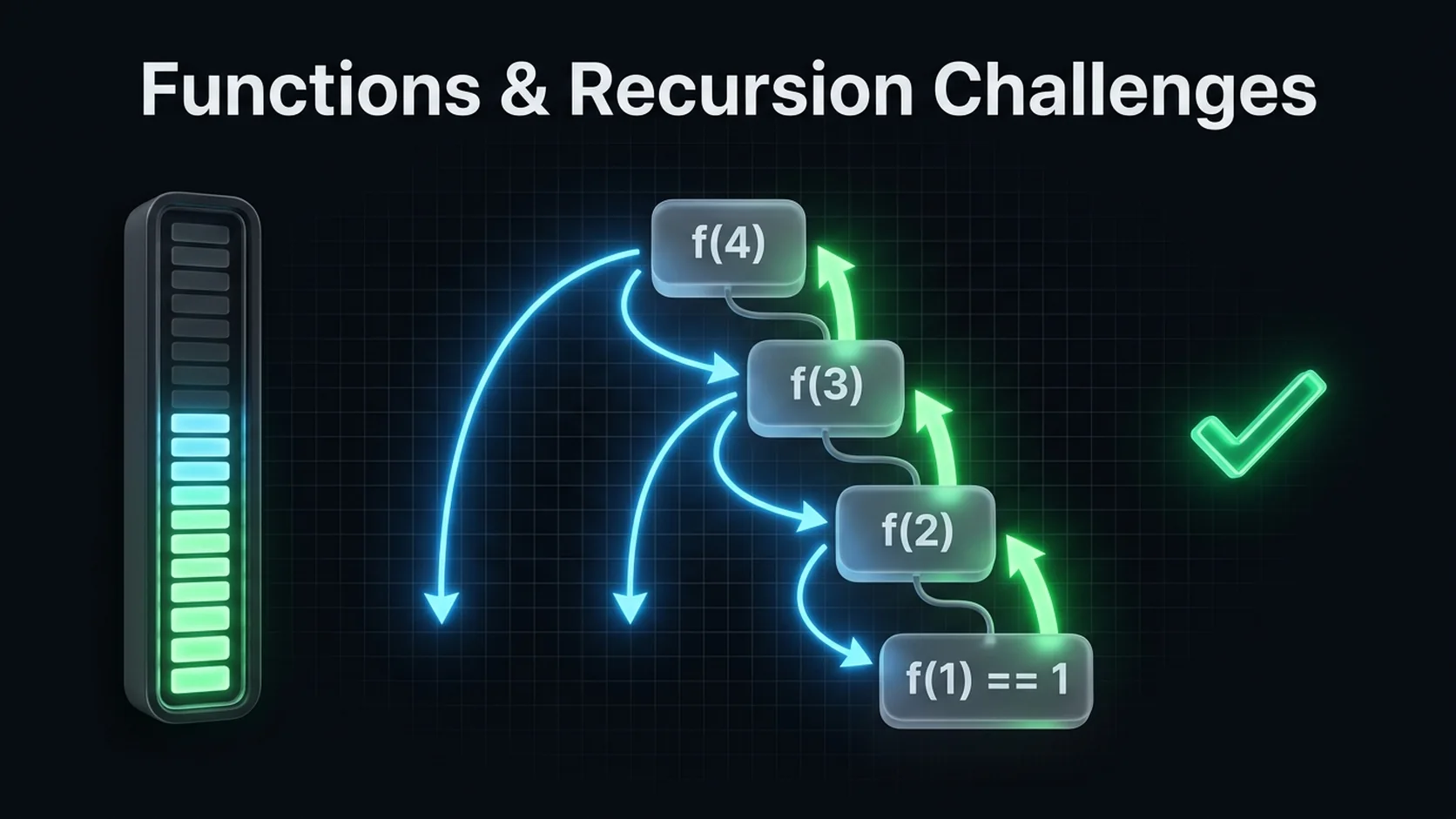
Problem Statement
Write a recursive C function that computes the Greatest Common Divisor (GCD) and Least Common Multiple (LCM) of an array of K positive integers using the Euclidean algorithm and pointer pass-by-reference.
Real-World Systems Context
In digital signal processing (DSP), timer frequency prescalers, and task scheduling runqueues, computing common timing multiples across multiple hardware timers is a frequent operation. This challenge tests recursive mathematical derivation and modifying multiple return values via pointers.
Requirements:
- Implement
long long gcd(long long a, long long b)recursively using the Euclidean algorithm:gcd(a, b) = gcd(b, a % b)with base conditionb == 0. - Implement
long long lcm(long long a, long long b)using(a / gcd(a, b)) * bto prevent premature integer overflow. - Implement
void find_array_gcd_lcm(int k, long long arr[], long long *out_gcd, long long *out_lcm)using pointer dereferencing for output parameters.
Complexity & Editorial
Algorithmic Breakdown: Euclidean Recursion & Overflow Prevention
Calculating the GCD and LCM across an arbitrary array of integers requires combining recursive number theory with careful memory management:
The Recursive Euclidean Algorithm:
The Euclidean algorithm is based on the mathematical principle that the GCD of two numbers also divides their difference. Rather than subtracting repeatedly, the modulo operation computes the remainder in a single step:gcd(a, b) = gcd(b, a % b)
The base case triggers whenb == 0, returninga. This converges in logarithmic timeO(log(min(a, b))).Preventing Multiplication Overflow in LCM:
The mathematical formula for LCM is(a * b) / gcd(a, b). However, multiplyinga * bfirst can cause 64-bit integer overflow even if the final LCM would comfortably fit in along long.
By dividing first:lcm(a, b) = (a / gcd(a, b)) * b;
we guarantee that the intermediate quotient remains small, preventing arithmetic overflow.Pass-by-Reference in C:
Because C functions cannot return multiple values by value, we pass pointers (long long *out_gcd, long long *out_lcm). Dereferencing them (*out_gcd = current_gcd) directly mutates the caller's stack variables.
Starter Code
#include <stdio.h>

// Recursive Euclidean algorithm
long long gcd(long long a, long long b) {
    // TODO: Base case and recursive call
    return 0;
}

long long lcm(long long a, long long b) {
    // TODO: (a / gcd(a, b)) * b
    return 0;
}

// Function modifying outputs via pointers
void find_array_gcd_lcm(int k, long long arr[], long long *out_gcd, long long *out_lcm) {
    // TODO: Loop through array and accumulate overall GCD and LCM
}

int main(void) {
    int k;
    if (scanf("%d", &k) != 1 || k < 2) return 1;

    long long arr[10];
    for (int i = 0; i < k; i++) {
        scanf("%lld", &arr[i]);
    }

    long long result_gcd = 0;
    long long result_lcm = 0;

    find_array_gcd_lcm(k, arr, &result_gcd, &result_lcm);

    printf("Array GCD: %lld | Array LCM: %lld\n", result_gcd, result_lcm);
    return 0;
}
Frequently Asked Questions
Can this recursive GCD function cause a stack overflow?
No, because the Euclidean algorithm reduces values by at least half every two steps (Lamé's Theorem). The maximum recursion depth rarely exceeds 50 frames even for 64-bit integers.
Why does C not allow returning multiple values like Python or Go?
C is a low-level language designed to map cleanly onto CPU architectures. Hardware return registers (like RAX on x86-64) hold only a single scalar value. Returning multiple values is achieved via pointers or structs.