C99 vs C11 vs C17: What Changed and Which Standard to Use

Short answer: C99 modernised the language, C11 added compile-time checks, generic selection, alignment and atomics and removed gets(), and C17 only fixed defects in C11. For new code, compile with -std=c17 (or -std=c11) and add -pedantic-errors; reach for -std=c99 or -std=c89 only when a toolchain or coding standard requires it.
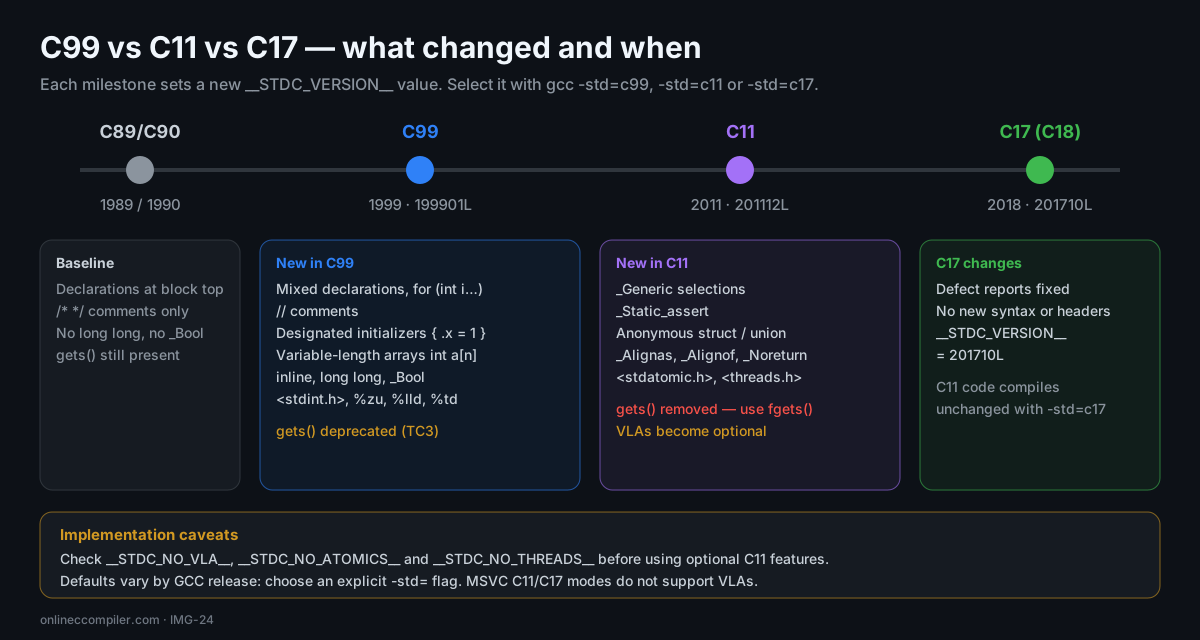
Timeline of C99, C11 and C17 milestones with implementation caveats

C89/C90: the baseline

ANSI C (1989), adopted by ISO in 1990, is the oldest standard still selected with -std=c89 or -std=c90. Declarations must appear at the start of a block, only /* */ comments exist, there is no long long and no boolean type, and __STDC_VERSION__ is not defined.

What C99 added

  • Declarations mixed with statements, including for (int i = 0; ...) loop counters.
  • // line comments, designated initializers and compound literals.
  • long long, _Bool with <stdbool.h>, and fixed-width types in <stdint.h>.
  • inline functions, variable-length arrays and snprintf.
  • The %zu, %td and %lld conversions for size_t, ptrdiff_t and long long.

What C11 added and removed

  • _Static_assert for compile-time checks and _Generic for type-based selection.
  • Anonymous structures and unions, _Alignas/_Alignof and _Noreturn.
  • _Atomic with <stdatomic.h> and <threads.h>; both are optional for implementations.
  • Variable-length arrays became optional (__STDC_NO_VLA__).
  • gets() was removed because it cannot limit how much input it stores; use fgets.

What C17 changed

C17, published as ISO/IEC 9899:2018 and also called C18, is a maintenance revision. It adds no language features; it resolves defect reports against C11 and sets __STDC_VERSION__ to 201710L. GCC accepts both -std=c17 and -std=c18. The next revision, C23, is selected with -std=c23 in recent GCC and Clang releases.

Comparison table

StandardDocumentGCC/Clang flag__STDC_VERSION__Main changes
C89/C90ANSI X3.159-1989 / ISO/IEC 9899:1990-std=c89not definedANSI C / ISO C90: declarations only at the top of a block, /* */ comments only, no long long.
C99ISO/IEC 9899:1999-std=c99199901LMixed declarations, // comments, designated initializers, VLAs, inline, long long, _Bool.
C11ISO/IEC 9899:2011-std=c11201112L_Generic, _Static_assert, anonymous struct/union, _Alignas, _Noreturn, <stdatomic.h>, threads; gets() removed; VLAs optional.
C17ISO/IEC 9899:2018-std=c17201710LDefect-fix revision of C11 (also called C18): no new language features, __STDC_VERSION__ becomes 201710L.

Check which standard your compiler uses

Compile the same file with each flag. With -pedantic-errors, code that needs a newer standard fails to build instead of compiling as an extension.

gcc -std=c89 -pedantic-errors -Wall -Wextra main.c -o main
gcc -std=c99 -pedantic-errors -Wall -Wextra main.c -o main
gcc -std=c11 -pedantic-errors -Wall -Wextra main.c -o main
gcc -std=c17 -pedantic-errors -Wall -Wextra main.c -o main

This program prints the standard the compiler is using. Built with -std=c17 it prints __STDC_VERSION__ = 201710L.

#include <stdio.h>

int main(void) {
#ifdef __STDC_VERSION__
    printf("__STDC_VERSION__ = %ldL\n", __STDC_VERSION__);
#else
    puts("__STDC_VERSION__ is not defined (C89/C90)");
#endif
    return 0;
}
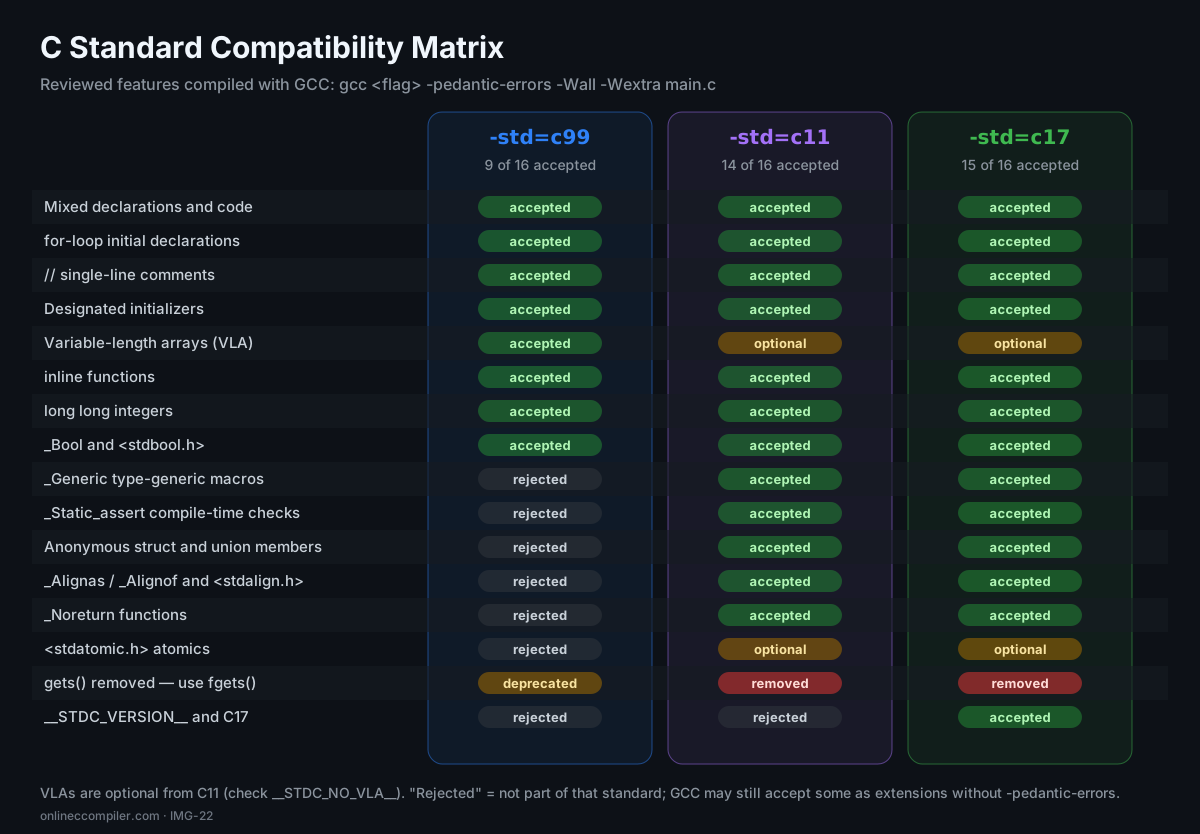
Try it: C standard compatibility matrix

Filter reviewed C language features by standard or category, see which -std= flag accepts each one, then load the runnable fixture — or a probe demonstrating rejection or an implementation extension — into the compiler.

16 features reviewed

FeatureC89/C90-std=c89C99-std=c99C11-std=c11C17-std=c17
Not availableSupportedSupportedSupported
Not availableSupportedOptionalOptional
Not availableSupportedSupportedSupported
Not availableNot availableSupportedSupported
Not availableNot availableOptionalOptional
SupportedDeprecatedRemovedRemoved
Not availableNot availableNot availableSupported
Show the -std=c99 / c11 / c17 lanes diagramMatrix of reviewed C features in -std=c99, -std=c11 and -std=c17 lanes with accepted, optional, removed and rejected badges

_Generic type-generic macros

Added in C11 · minimum flag -std=c11

_Generic picks an expression at compile time from the type of its controlling argument — the basis for type-generic macros like <tgmath.h>.

#include <stdio.h>

#define TYPE_NAME(x) _Generic((x), \
    int: "int", \
    double: "double", \
    char *: "char *", \
    default: "other")

int main(void) {
    char text[] = "hi";
    printf("%s\n", TYPE_NAME(42));
    printf("%s\n", TYPE_NAME(3.14));
    printf("%s\n", TYPE_NAME(text + 0));
    return 0;
}
gcc -std=c11 -pedantic-errors -Wall -Wextra main.c -o main
$ gcc -std=c11 -pedantic-errors -Wall -Wextra main.c -o main && ./main
int
double
char *

Compiled without diagnostics · exit code 0

Representative GCC output, not a live run. Diagnostic wording, line and column numbers vary between compiler versions.

Need the conversions for a particular type? Open the printf and scanf format specifier cheat sheet. The full-page C standard compatibility checker hosts the same matrix with more room, and Turbo C vs modern C covers code written for pre-standard compilers.

Ready to try it? Open the online C compiler, paste a program and run it, or read the C error guides when a build fails.

Frequently asked questions

What is the difference between C11 and C17?

C17 (ISO/IEC 9899:2018, also called C18) adds no new language features. It incorporates corrections to defects reported against C11 and changes __STDC_VERSION__ to 201710L. Code that compiles as C11 normally compiles unchanged as C17.

Should I use C99, C11 or C17 for new code?

Use -std=c17 (or -std=c11) unless a toolchain or coding standard requires older C. It includes everything in C99 plus _Static_assert, _Generic, alignment control and atomics. Choose -std=c99 only for compilers that lack C11 support.

Was gets() removed in C11?

Yes. gets() was deprecated by a 2007 technical corrigendum to C99 and removed in C11 because it cannot limit how much input it stores. Use fgets(buf, sizeof buf, stdin) instead.

Are variable-length arrays allowed in C11?

C99 required variable-length arrays; C11 made them optional, and an implementation without them defines __STDC_NO_VLA__. GCC and Clang support them, but Microsoft Visual C++ does not.