Turbo C vs. Modern C Compilers (GCC & Clang Architecture)
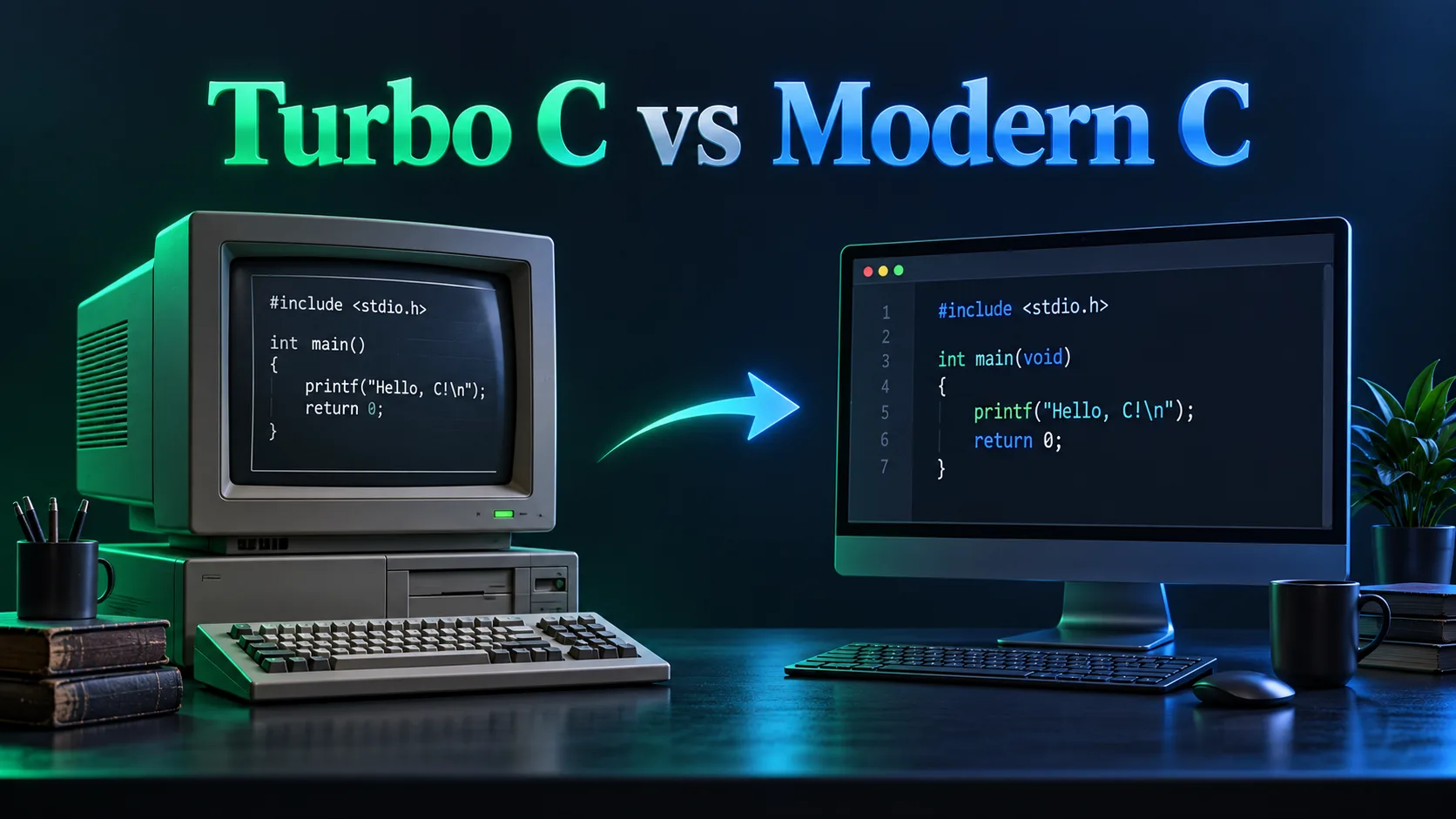
Turbo C 2.0 and 3.0 (released by Borland in the late 1980s for 16-bit MS-DOS) remain lingering relics in some introductory academic curricula. However, teaching Turbo C today introduces hazardous misconceptions about hardware, memory models, and standard C compliance. Here is an architectural comparison between 16-bit real-mode Turbo C and modern 64-bit ISO C17/C23 compilers like GCC and Clang.
1. The 16-Bit Real Mode vs 64-Bit Virtual Memory Divide
• Turbo C (MS-DOS 16-bit real mode): In Turbo C, sizeof(int) is only 2 bytes (-32,768 to +32,767). Memory is physically segmented into 64 KB segments requiring complex "Near", "Far", and "Huge" pointer qualifiers. • Modern C (GCC / Clang on 64-bit OS): sizeof(int) is 4 bytes (up to 2.14 billion), pointers are 8 bytes (64 bits), and execution occurs within a flat, uniform virtual address space protected by kernel MMU page tables.
2. The Obsolete <conio.h> Problem: getch() and clrscr()
Turbo C relied heavily on non-standard MS-DOS BIOS interrupts exposed via <conio.h> functions like getch() and clrscr(). These headers do NOT exist in the ISO C standard. Writing <conio.h> code produces immediate fatal compiler errors on Linux, macOS, and modern GCC/Clang toolchains.
3. Standard ISO C Replacements for Turbo C Antipatterns
• Replace non-standard void main() with standard int main(void) returning 0. • Replace getch() with standard getchar() or scanf(). • Replace clrscr() with cross-platform ANSI terminal escape codes: printf("\033[H\033[J");.
Runnable C example
#include <stdio.h>

int main(void) {
    printf("========================================\n");
    printf("Modern ISO C17/C23 Environment Diagnostic\n");
    printf("========================================\n");
    printf("Int Size     : %zu bytes (Turbo C was 2 bytes)\n", sizeof(int));
    printf("Pointer Size : %zu bytes (Turbo C was 2/4 bytes segmented)\n", sizeof(void*));
    printf("Long Size    : %zu bytes\n", sizeof(long));
    printf("Status       : Running on High-Speed Modern GCC Sandbox\n");
    return 0;
}Expected Output
========================================
Modern ISO C17/C23 Environment Diagnostic
========================================
Int Size     : 4 bytes (Turbo C was 2 bytes)
Pointer Size : 8 bytes (Turbo C was 2/4 bytes segmented)
Long Size    : 8 bytes
Status       : Running on High-Speed Modern GCC Sandbox
Frequently Asked Questions
Why should I avoid installing Turbo C on Windows 11 or 10?
Turbo C cannot run natively on 64-bit Windows without a 16-bit DOSBox emulator, lacks modern debuggers like GDB and Valgrind, ignores 35 years of standard ISO C updates, and teaches bad habits that fail code reviews in industry.
Can I write and compile modern C code without local compiler setup?
Yes! Our Online C Compiler runs modern GCC directly in your web browser with zero installation required.