History & Evolution of C Programming Language
Developed by Dennis Ritchie at Bell Laboratories in 1972 to build the Unix operating system, C transformed modern computing. Its design became the foundation for C++, Java, C#, and JavaScript. Understanding the history of C language helps you appreciate why modern software systems are structured the way they are today.
1. The Origins: From BCPL and B to C (1969–1972)
In the late 1960s, Ken Thompson and Dennis Ritchie needed a flexible programming language to develop Unix for the DEC PDP-11 computer. Thompson first created B (inspired by Martin Richards' BCPL). But B was typeless and could not easily take advantage of the hardware features of the PDP-11. Dennis Ritchie stepped in, added distinct data types, memory structures, and a native compiler, officially giving birth to the C programming language in 1972.
2. The Unix Revolution (1973)
In 1973, Ritchie and Thompson took the bold step of rewriting the entire Unix kernel in C. At the time, this was unheard of: operating systems were almost universally handwritten in assembly code tailored to a single machine architecture. Rewriting Unix in C proved that an operating system could be portable across completely different computer hardware without sacrificing performance.
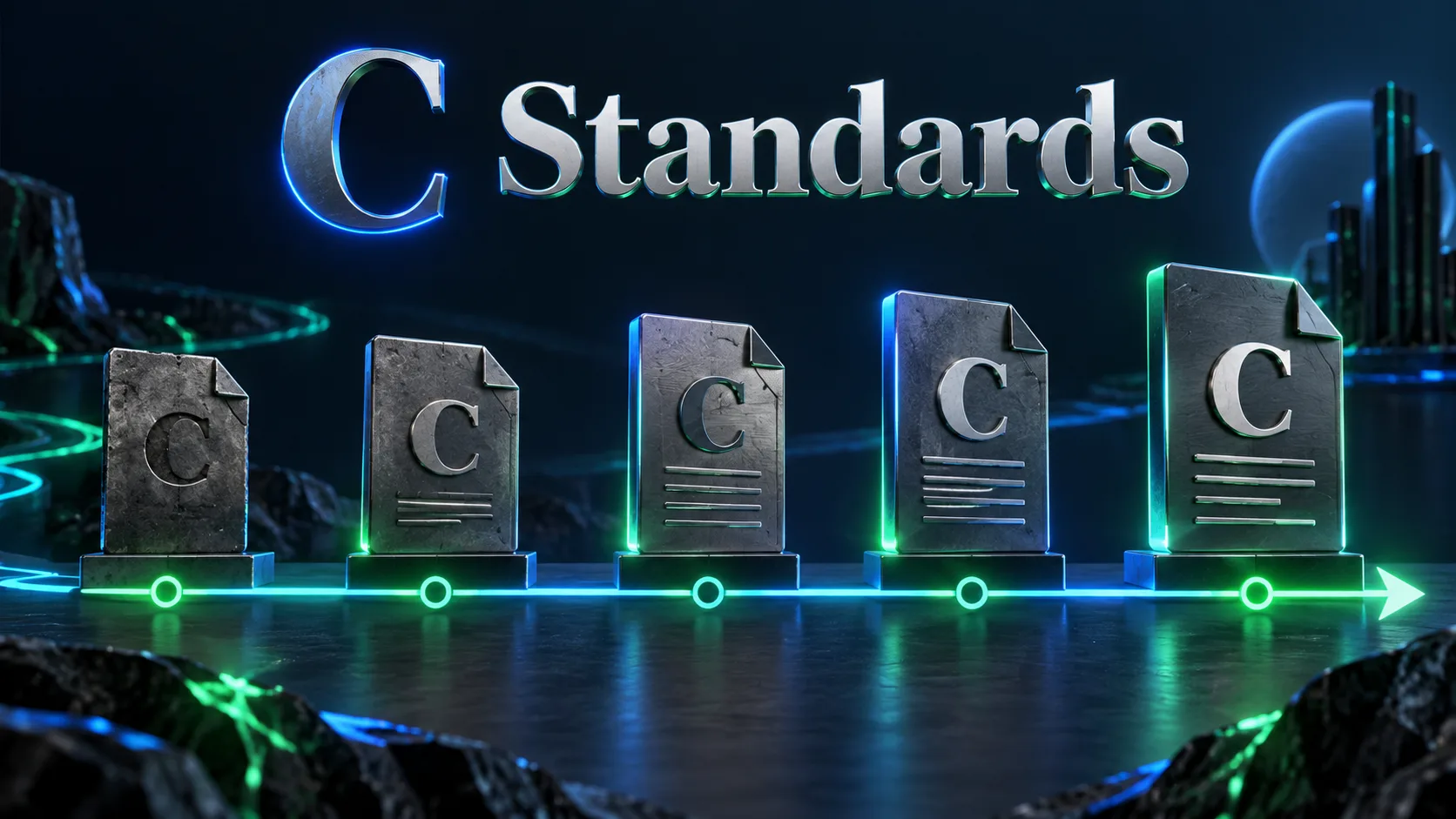
3. The Evolution of C Language Standards Timeline
• K&R C (1978): Brian Kernighan and Dennis Ritchie published "The C Programming Language", establishing the original de facto standard. • ANSI C / ISO C90 (1989/1990): Formalized function prototypes, header libraries, and void pointers. • C99 (1999): Introduced variable-length arrays, inline functions, and fixed-width integer types in <stdint.h>. • C11 (2011): Added native multithreading (<threads.h>), atomic operations, and type-generic expressions. • C17 (2018): Cleaned up defect reports and technical ambiguities without introducing breaking changes. • C23 (2024–2026): Modernized C with native nullptr, typeof, attributes, and binary integer literals.
Frequently Asked Questions
Who is the father of C language?
Dennis MacAlistair Ritchie (1941–2011), an American computer scientist at Bell Labs.
Why was the language named "C"?
Because it was the direct successor and evolutionary upgrade of Ken Thompson B programming language.